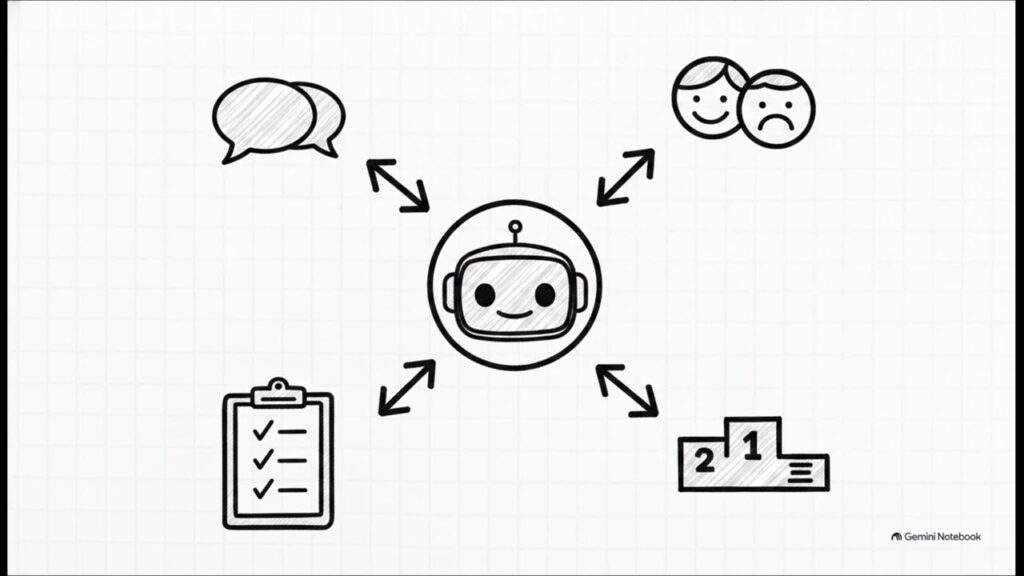
The online visibility landscape has fundamentally shifted from traditional SEO to answer engine optimization (AEO), where AI generates answers for buyers. If your company isn’t mentioned in these AI-generated responses, you become invisible to potential customers. The Adomo platform offers a solution to measure and improve your AI visibility, ensuring your brand is cited when…
This video plays from YouTube, which can set cookies on your device.
Traditional SEO rankings do not guarantee visibility in AI-generated answers, as AI favors third-party evidence over first-party claims.
AI citations experience decay, typically disappearing within six months, necessitating a continuous strategy to maintain visibility.
The Adomo platform measures AI visibility by simulating buyer questions across multiple AI engines and meticulously tracking brand mentions, sentiment, and source citations.
Improving AI visibility requires a five-move playbook: answering questions publicly, appearing in comparisons, earning community mentions, refreshing content regularly, and measuring results.
Adomo provides a closed-loop system, using modules like Radar, Voice, and Reach to identify visibility gaps, create content, publish it, and then measure the impact on AI visibility.
Welcome to this explainer where we're going to dive into the massive tectonic shift happening right now in online visibility. We are officially moving away from traditional SEO and stepping head first into the era of answer engine optimization using the Adomo platform. Look, if you're a marketer, a founder, or anyone responsible for growth, you already know the ground beneath your feet has fundamentally changed. Today, we're going to map out exactly how to navigate it. Let's jump straight in with a pretty stark reality. Search used to be a directory, right? It gave you 10
blue links, sent people to your website, and let you make your pitch. Well, not anymore. Now, it answers for you. An AI generates a single coherent paragraph. And here is the kicker. If your company isn't mentioned in that paragraph, you're completely invisible to the buyer. Literally out of sight, out of business. So, let's start with section one, the invisible AI buyer. Right now, at this exact moment, someone evaluating your entire category is typing a question into an AI chat, like chat, GPT, Perplexity, or Google AI. They're
asking for recommendations, comparisons, you name it. And if you're a traditional marketer, this is the terrifying part. Your buyers asked an AI about your category today, and you have absolutely no clue what it told them. You see, traditional analytics just can't track this activity. If a buyer clicks a link to your site and leaves, sure, your analytics track a bounce. But if an AI engine simply leaves you out of the generated answer entirely, nothing in your analytics will ever tell you what happened. You honestly don't know if you made the short list or were just completely ignored. Moving right along
to section two, SEO versus answer engines. It's a really dangerous assumption to think your existing SEO strategy is going to save you here. Industry research clearly shows that SEO rankings barely correlate with AI citations. You can totally own page one of Google and still be a ghost in AI answers. Why is that? Because SEO relies on first party claims. It's basically your website telling the world how great you are. Answer engines, on the other hand, favor third party evidence. They are actively looking for consensus across the web, not just what you're
saying about yourself. Which brings us to the new goal, answer engine optimization or AEO. This is the practice of making absolutely sure that AI engines actually mention your company when buyers ask for recommendations. This isn't about ranking some specific keyword on a specific page. It's about making sure your brand is the definitive answer generated by the AI. This is the shared vocabulary we're going to be using moving forward. Okay. Section three, the citation decay problem. We
have to talk about a harsh reality regarding how these AI engines manage their sources. It's a little thing called citation decay. Studies show that most AI citations disappear within about 6 months. These engines are just constantly refreshing their sources to provide the most up-to-date answers possible. What this proves is that AO is absolutely not a oneanddone project. You can't just run a single campaign, get cited, and walk away. It's a steady cadence you have to maintain or else your visibility simply evaporates. Which leads us directly into section four,
measuring your AI visibility using Edomiro. So, how do we actually measure this invisible landscape? We know the invisible buyers out there and we know citations decay. Well, stops the guessing game. It runs realistic buyer questions on a set schedule against multiple AI engines. ChachiBT, Perplexity, Google AI, all the big ones. It asks the questions exactly as a buyer would and then it records those answers in full. It meticulously tracks the really crucial details. Were you named? Where was your exact position in the
answer? What was the sentiment and tone? Which competitors showed up instead of you? and crucially, what were the cited sources? To actually make sense of all this data, Adomero breaks down visibility into expectation bands based on the buying stage. You'll want to pay close attention to these benchmarks. If a buyer asks a direct question, meaning they literally ask about your company by name, you should be visible 80% of the time or more. If you're dropping below 50% there, the AI can't even describe you when directly asked. Now, for category questions like, you know, what
are the best tools for X, appearing in 20 to 40% of answers is considered highly competitive because the AI is only naming a few companies at once. But look at problem questions where a buyer describes a pain point without even naming a category. Expecting near zero visibility here is actually totally normal, even for incredibly strong brands. So if you have literally any presence at all on problem based questions, it means the AI engine has a massive deep association with your brand as the definitive solution to that specific problem. That's a huge win. Now when Admir tracks where these AI engines
are getting their information, Plexity and Google AI actually publish their sources. Admira sorts these into your pages, competitor pages, and what we call neutral ground. What you'll quickly find is that AI engines build answers mostly from this neutral ground. We're talking forums, review sites, directory listings, independent comparison articles. They heavily favor this third-party evidence over your own perfectly crafted product pages. Oh, and as a quick note of transparency, Chat GPT doesn't publish its sources, and Adamero's Daxboard makes that explicitly clear rather than just guessing and
giving you bad data. So, to prove your efforts are actually working, there are two core numbers you need to track quarter over quarter in your Atomro dashboard. First is your AI presence grade. This is a 0 to 100 score, basically an A to F letter grade that weighs your visibility and sentiment, leaning heavily on decision stage questions. Second is the Adomo index. This is a community benchmark that places you in a percentile against everyone else measuring visibility on the platform. These are the hard numbers you take to leadership. All right, let's
bring it all together in section 5, the five move playbook. We know how to measure it, but what actually improves your AI visibility? Adamro provides a specific framework for this. We can walk methodically through the exact five move AO playbook right now. Step one, answer real questions in public. Put the direct answer in the first 100 words of an independent article. Step two, show up where buyers compare. Step three, earn genuine community mentions. Step four, refresh on a cadence to fight that six-month citation decay we talked about
earlier. And finally, step five, measure before you guess, using weekly reports to see which bets actually paid off. I really want to emphasize steps two and three for a second. Comparison articles like those best tools for lists and genuine community discussions on professional networks or forums, those are the absolute strongest trust signals for AI engines. Remember, engines favor third party consensus. Being listed naturally next to your competitors is infinitely better for AI visibility than just having a slick landing page about
yourself. What makes Adomo so uniquely powerful is that it isn't just a passive measurement tool. It is a closed loop. When their AI visibility tool finds questions you're missing from, those gaps instantly become a task. Let's break down the modules. The radar module finds the missing questions. The voice module turns those gaps into draft content briefs. The reach module helps you publish it across channels. And then the AI visibility module runs the next week to measure if the answer actually changed. You are constantly identifying blind spots and automatically turning
them into actionable work. It's a gamecher. I want to leave you with this final provocative thought. You absolutely cannot fix a short list that you can't see. Your buyers are using AI right this very second to make decisions about your category. If you aren't actively measuring your answer engine optimization, you are flying totally blind in the single most critical phase of the modern buyer's journey. So ask yourself, are you currently out of sight? Because if you're out of sight in the AI era, you're out of business. It
We use a small number of cookies to run this site and, if you allow it, to understand how it is used. Learn more
Cookie preferences
Strictly necessary
Required for the site to work. Cannot be turned off.
Cookies in this category (12)
Name
Provider
Purpose
Duration
adamiro_consent
Adamiro
Stores your cookie preferences.
12 months
wordpress_logged_in_*
Adamiro (WordPress)
Keeps you signed in. Only set once you log in.
Session
wordpress_sec_*
Adamiro (WordPress)
Secures your authenticated session on HTTPS.
Session
wp-settings-*
Adamiro (WordPress)
Remembers your admin/dashboard interface preferences.
1 year
adm_2fa_trust
Adamiro
Remembers a trusted device so two-factor login isn\'t required every time.
Up to 30 days
adm_fr_runs
Adamiro
Counts how many times this browser has used the free First Round board, so the free tool cannot be run without limit. Holds a count and a date, never your input.
7 days
adm_slt_runs
Adamiro
Counts how many times this browser has used the free Sounds Like Them test, so the free tool cannot be run without limit. Holds a count and a date, never your input.
7 days
__stripe_mid
Stripe
Fraud prevention for card payments. Set by Stripe while a card form is open, on checkout and on the page where a new account owner adds their card.
1 year
__stripe_sid
Stripe
Fraud prevention for card payments. Stripe\'s short-lived session marker while a card form is open.
30 minutes
adamiro_dl
Adamiro
Remembers that you confirmed your Adamiro Signals subscription, so downloads open without signing up again. Only set once you confirm.
12 months
adamiro_currency
Adamiro
Remembers the currency you chose for prices. Only set when you pick one.
12 months
adm_oauth_bind
Adamiro
Makes sure a social-account connection you start is completed in the same browser, so nobody else can attach their account to yours. Only set while you connect an account in Reach, and removed when the connection finishes.
10 minutes
Analytics
Helps us understand aggregate site usage. Off by default.
Cookies in this category (2)
Name
Provider
Purpose
Duration
_ga
Google Analytics (via Site Kit)
Distinguishes visitors for aggregate traffic measurement.
13 months
_ga_*
Google Analytics (via Site Kit)
Persists GA4 session state for this property.
13 months
Marketing
Used to measure and personalize marketing.
Cookies in this category (2)
Name
Provider
Purpose
Duration
VISITOR_INFO1_LIVE
YouTube (Google)
Set by YouTube when you play a video, to estimate bandwidth and remember player settings.
6 months
YSC
YouTube (Google)
Set by YouTube when you play a video, to tell playback sessions apart.