It’s 8:00 AM on a Tuesday. A product marketer opens her browser to write a launch announcement. On her screen are three files: next quarter’s product roadmap draft, an internal table with upcoming price changes, and raw notes from a private customer interview.
She wants to quickly draft three social posts and a short blog. She copies all the text and pastes it into a popular web chat AI (like ChatGPT, Gemini, or Claude), asking it to clean up the formatting and write headlines.
Within seconds, the AI returns four polished paragraphs. She copies them into her document, closes the browser, and joins her morning meeting. The whole process takes less than a minute.
She assumes closing the tab means her data is gone. In reality, with most chat apps, that text has just started its journey across remote servers. AI chat exposes you.
Here’s what really happens to that pasted text, why common AI chat tools put your business at risk, how Adamiro prevents these leaks, and what your team can do to stay secure.
Don’t want to read? Watch this video instead
1. The Bot Never Forgets:
The Data Retention Trap where AI chat exposes your data
Many people think a chat box is like a private calculator: you type, get an answer, and your input vanishes when you clear the screen.
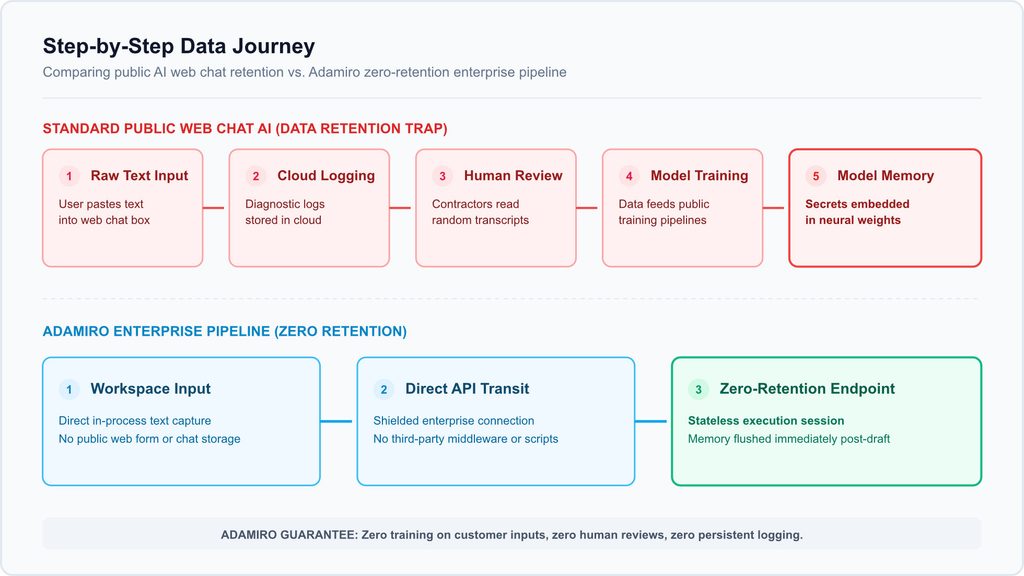
But AI chats follow a very different, four-step process.
First, your text is logged in the cloud.
As soon as you hit send, your notes travel across the internet into cloud storage logs. Even if you delete the chat, the hosting provider keeps the server logs for audits and troubleshooting.
Second, human reviewers may read your chats.
Major AI vendors hire contractors to check random chat logs for quality and safety. Your private notes or pricing tables could appear on someone’s screen anywhere in the world.
Third, your data is used to train the AI.
Unless your company pays for strict no-retention contracts, your inputs help teach future versions of the AI how to communicate and make decisions.
Fourth, your secrets become part of the AI itself.
Once your information is used in training, it’s embedded deep in the model’s memory. Removing it means retraining the whole system, an expensive and rarely done process. Your data can stay in the AI’s memory forever.
Months later, a competitor asks the same public AI about industry pricing trends. The AI pulls from what it has learned and generates a response that closely matches your confidential pricing.
How Adamiro fixes it: Adamiro stops this data chain at the source. It never uses public chat apps or consumer web forms. Instead, Adamiro connects directly to model providers using encrypted channels and strict enterprise agreements.
With these terms, your inputs and drafts are processed in private sessions. They’re never stored in vendor datasets, never reviewed by outside teams, and never used to train public models. Your work stays within your workspace.
2. When the Bot Spills Secrets
AI tools use hidden instructions called system prompts. These guide the bot’s behavior, tone, and safety rules. In business apps, system prompts can include sensitive logic, database details, and background info.
Hackers and curious users have learned that AI models can confuse system instructions with user inputs. By using manipulative prompts (known as jailbreaks or prompt injection), attackers can trick the bot into revealing its hidden instructions, internal guidelines, or even private background files.
How Adamiro fixes it: Adamiro keeps system logic and user text completely separate. Intelligence routines run in isolated backend systems, so background instructions never mix with user prompts. Even if someone tries to trick the AI, it can’t access database credentials or configuration files—there’s nothing private for it to spill.
3. When the Wrong Person Gets Access
To help AI answer business questions, platforms use context search. They break documents into chunks, turn them into searchable keys, and store them in an index. When someone asks a question, the system pulls in matching document pieces.
Problems start when all company documents are stored in one big search index with weak permission controls. If an intern, sales rep, or contractor all use the same tool, the AI might surface confidential documents to the wrong person. For example, a freelancer asking about quarterly goals could get an answer built from executive salary data just because both mention company performance.
How Adamiro fixes it: Adamiro separates stored data by organization and account. Private strategy notes are kept apart from general files. Before any search, the system checks user permissions. If someone isn’t allowed to see a document, it’s excluded from their search results.
4. Unprotected Text in Database Storage
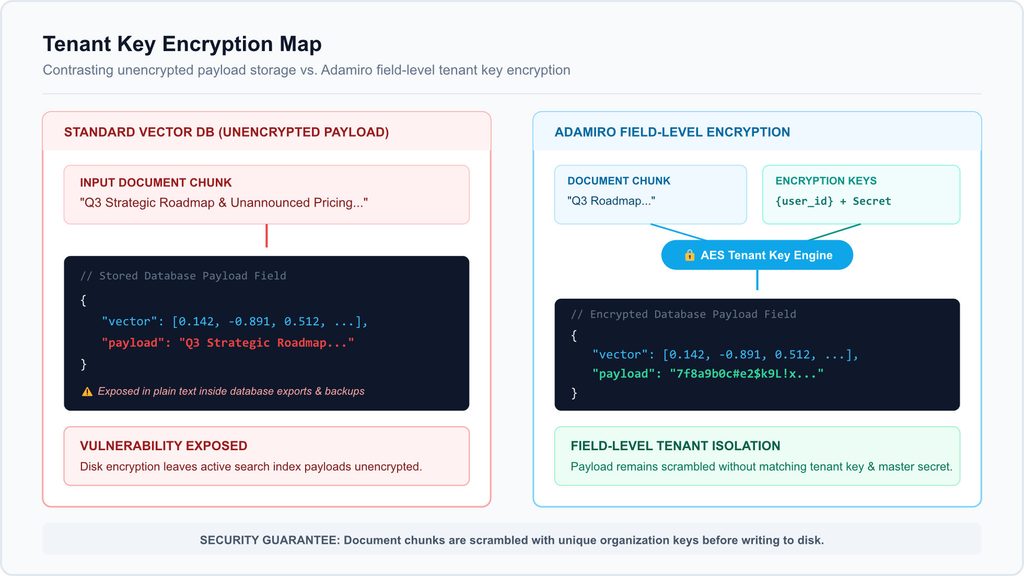
AI tools speed up search by turning text into long strings of numbers called embeddings. But to show search results, they also keep the original text in the database right next to those numbers.
Many setups only use basic hard-drive encryption. This protects the physical server, but leaves the text inside the search index unencrypted. If someone gets a database backup, every quote, strategy doc, and draft could be visible in plain text.
How Adamiro fixes it: Adamiro encrypts sensitive database fields and search results at the field level. Each customer gets a unique encryption key based on their organization and a master key. Even if someone steals the full database, the text is scrambled. Without the right key, it can’t be read.
5. When Servers Get Tricked Into Scanning Your Network
AI tools often need to read web pages, competitor blogs, or product pages. When a user pastes a URL, the backend server fetches the page’s text.
Without strict network filters, this opens the door to Server-Side Request Forgery (SSRF) attacks. A user could enter a web address that secretly points to an internal company server or private cloud resource, tricking the backend into probing systems behind your firewall.
How Adamiro fixes it: Adamiro runs every URL through a strict filter before connecting. Every address is checked against a blocklist of internal and private IP ranges. If a link tries to redirect to a private address, the request is immediately stopped.
6. When Sensitive Data Passes Through Middlemen
Many AI tools connect different software platforms using external automation services, third-party webhooks, or public scripts.
Every extra third-party server your data travels through increases the risk of exposure. Unsecured webhooks, exposed callback URLs, and public scripts create more chances for attackers to intercept your information.
How Adamiro fixes it: Adamiro never routes your data through third-party workflow tools or middleware scripts. All processes run within Adamiro’s backend, and your data moves directly and securely from the application to enterprise AI endpoints.
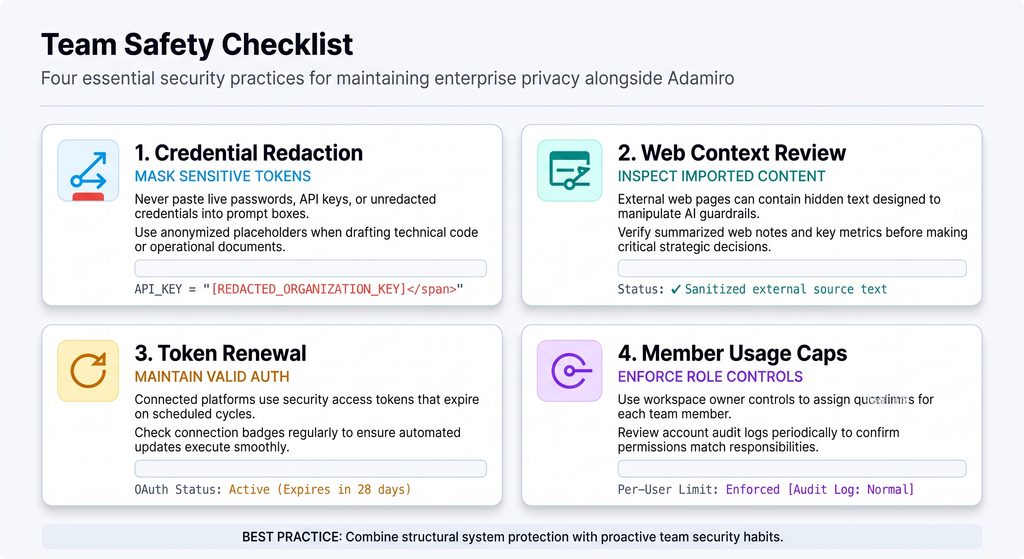
Four Simple Security Steps for Your Team
Adamiro’s architecture protects your data, but your team still needs to use smart security habits every day.
Never paste real passwords, database keys, or sensitive numbers into prompt boxes. Use fake placeholders when drafting technical documentation.
Check imported web content for hidden text that could manipulate AI tools. Always review web summaries before making important decisions based on them.
Keep your platform connections up to date. Social media channels use tokens that expire, so check and renew them regularly to avoid disruption.
Set account limits for your team. Use owner controls to cap each member’s usage, and check audit logs to ensure permissions match everyone’s role.
You don’t have to sacrifice business privacy to use generative AI. With strong system protection and smart team habits, you can build intelligence and create content quickly, without leaking sensitive data.